.png)
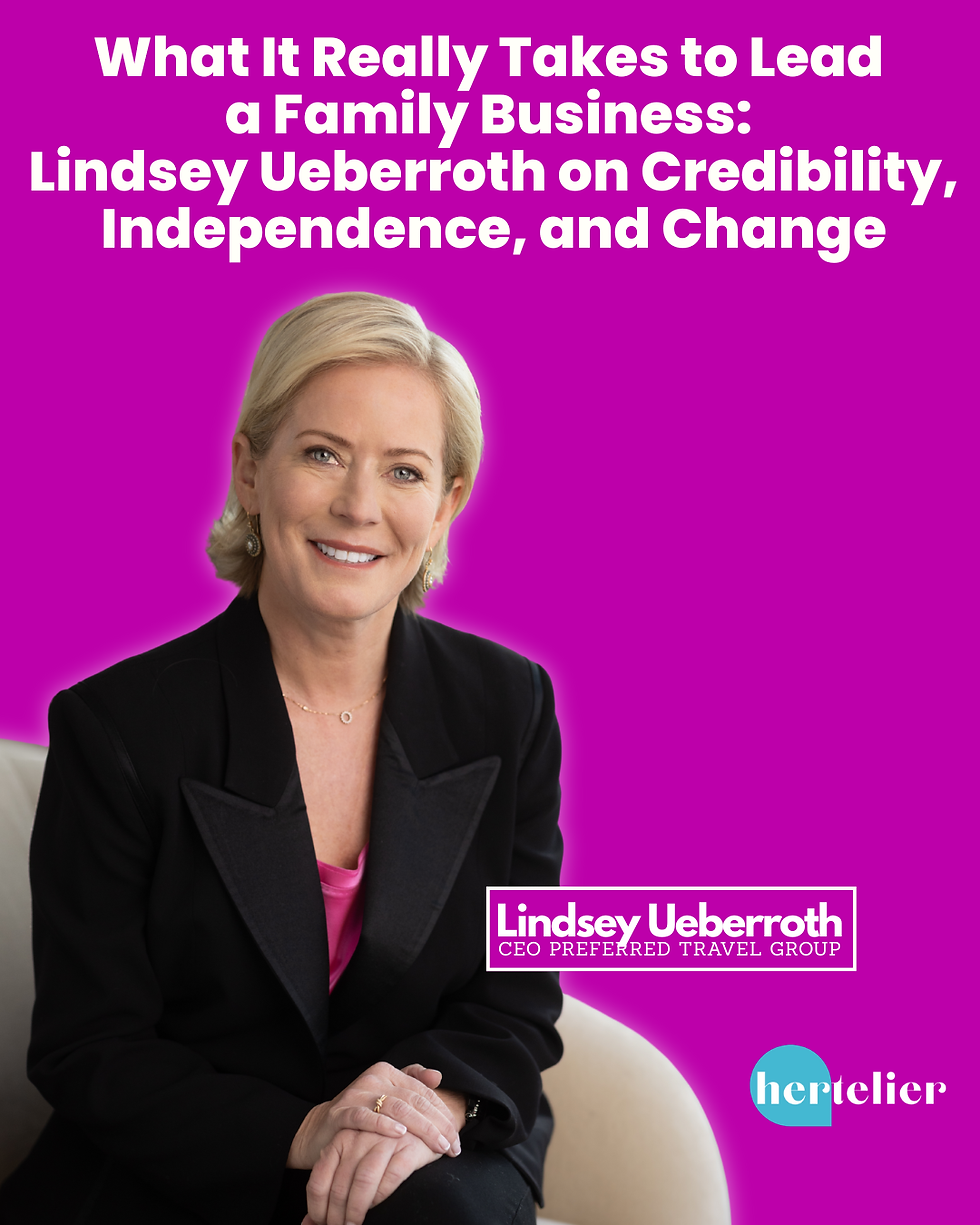
What It Really Takes to Lead in a Family Business: Lindsey Ueberroth on Credibility, Independence, and Change

Hertelier Leadership Conversations A recurring series of candid conversations with women leading at the highest levels of hospitality, unpacking ambition, responsibility, impact, and what it really takes to hold all three at once.
Lindsey Ueberroth didn’t set out to lead her family’s travel company. She started in consulting, built her early career in change management, and assumed her path would stay neatly outside the family business.
Instead, she found herself drawn into travel’s less shiny but more interesting work: integration, transformation, and eventually, the challenge of helping rebuild a business in turnaround mode. Over the next two decades, she took on role after role across Preferred, now known as Preferred Travel Group, deliberately collecting the kind of operational and commercial credibility you can’t fast-track or dismiss as a “nepo baby” narrative.
Her long arc carries weight now. The hotel landscape is shifting fast. Independent hotels are being courted from every angle, soft brands are in demand, and differentiation is no longer about who has the biggest footprint. It’s about who protects standards, drives demand, and stays true to the identity of the properties they represent.
The timing feels fitting, with Independent Hotel Day being marked today, celebrating the individuality and spirit of independently owned hotels and the anniversary of Preferred Hotels & Resorts’ founding. At ILTM Cannes, Lindsey sat down with Emily Goldfischer to reflect on the career path she didn’t plan, the credibility she had to earn, and why true independence matters more than ever.
Did you always see yourself in a family business?
If you had asked me when I was in college if I would ever be in a family-run business, I would have said not a chance in the world.
But the reality is, I grew up as a child of parents in the travel business. My mom was a flight attendant, and my dad ran many different types of travel-related businesses, so travel was in my DNA. I went to work after college for Andersen Consulting, now Accenture, and I got into change management.
Then after 2000, when the world was supposed to come to an end, I took a little bit of a leave of absence to travel. At that time my dad was acquiring a bunch of travel-related entities and he needed help with change management. It was integration of people, processes, technologies, and that was what I was doing in consulting, so that was my first step into working on the travel side. And I realized I loved it. It was in my blood.
When the opportunity came around for my family to purchase Preferred Hotels & Resorts, my father never asked me to come work for the business. He asked if I wanted to come to some meetings with him. At the time, he was meeting with hotels and the company was in some financial trouble. And I fell hook, line, and sinker. It was a turnaround situation, but it was something we were passionate about because we believe in travel. That’s really our brand ethos. That is how I ultimately ended up as part of the family business.
And I always remind people I didn’t start out as CEO. I’ve worn so many hats in this company. I oversaw IT, meetings and events, sales. I opened up our Newport Beach office. I did a lot. There was a long arc to my journey in terms of leadership within the family business.
Family business comes with assumptions. The term “nepo baby” comes to mind. How did you make sure people felt you’d earned your seat?
I tell people all the time that the hardest challenge in a family business is perception. People assume you’re underqualified and overpaid. And the irony is, in most family businesses, it’s often the opposite: you’re overqualified and underpaid, because families don’t want anyone to think things were handed to you.
I was very aware of that from the beginning. You have to recognize what people may be thinking and respond to it by rolling up your sleeves and working harder. For me, it also helped that I had worked outside the business. I knew I was qualified, and I was always willing to jump into new challenges. I never saw my career path as linear, and I never assumed I would end up in the CEO role.
When I was eventually promoted to president, we brought in outside advisors who spoke with our team, our clients, and our board. When the decision was made, it mattered to me that people felt I had earned it and that it wasn’t given. I wouldn’t have felt good any other way.
You’ve taken on a lot of different roles over the years. Which one felt most formative?
Launching our Preferred Boutique brand back in 2005 was a defining moment for me. The intention was to combine personal service, memorable experiences, and intimate surroundings with the highest level of quality. It was completely new, and I was involved from start to finish: naming it, setting the criteria, defining the positioning, even working through the pricing strategy. It was the first time we’d built something like that from the ground up.
There were a lot of headwinds. People questioned why we were doing it, whether anyone would want it, and the first two years were so hard. But there’s nothing more motivating to me than being told something can’t be done. Because it was a brand-new brand, I wore every hat. I had to understand how all the different segments fit together. Ultimately it was successful, and later we merged it back into the Preferred Hotels & Resorts brand as part of a broader rebrand. Having the experience of launching a brand, growing it, and then thoughtfully sunsetting it taught me more than any linear role ever could.
When something doesn’t go to plan, what’s your reset?
I always tell people it’s okay to be disappointed. It’s okay to wallow for a day or two. But after that, it’s about resilience.
I believe people learn faster from mistakes and failures. That’s what makes you stronger, because you know what you won’t do the next time you face something similar.
I’ve also been lucky to have strong mentors and sounding boards. My father has always been one of them. He’s a very humble leader and quick to say, brush it off, we’re on to the next. Let’s focus on what we can do better next time.
And I think moving a lot early in life helped build that mindset too. You learn that life goes on.
You’ve used executive coaching throughout your career. What does it help you see?
Tremendously. I actually have a coach again now, and I’ve worked with coaches off and on throughout my career. As you move further into leadership, it becomes even more important. It can get lonely at the top, and that’s real.
Coaching helps you see blind spots. A strength taken too far can become a weakness, and sometimes you don’t realize when that’s happening. Earlier in my career, coaching helped me identify the leadership traits I needed to develop. Now it’s more about patterns: why you do certain things, and how you change them.
I could go on and on about coaching. I think it’s such a gift, and I’ve always been a big proponent of it.
How do you know when it’s time to bring a coach back in?
I recently took one on after a conversation with a friend who works as an executive coach. She was talking about how companies can hit a wall when they have too many high performers. High performers sometimes think they don’t need to learn anything anymore. I remember laughing at first, and then walking away thinking, that might be me right now.
I’m always trying to figure out what’s next, and part of that is staying curious and willing to challenge yourself. It’s like going to the gym. There are times you’re in a great rhythm, and times you realize you need a trainer. Coaching is a good checkpoint for getting an outside perspective and continuing to push yourself forward.

Preferred just had its best growth year since 2019. What drove that momentum?
A lot went into it, but the headline is that in 2025 we added more than 70 net new hotels to Preferred Hotels & Resorts across our four collections, including 14 within the prestigious Legend Collection. We were also thrilled to welcome 20 new members to our Beyond Green brand. It came from being very intentional about how and where we grow. This wasn’t growth for growth’s sake. We focused on markets where we’re underrepresented or where we see real potential.
At the same time, we’ve put a lot of energy into brand positioning and continued to invest in quality assurance at the luxury level. We’ve invested in our team in the field, in technology, in marketing, and in loyalty. All of that together made this our strongest growth year since 2019.
The soft brand ecosystem has changed quickly. What still differentiates Preferred?
When the big chains decided to get into our space, it validated what we do. But our focus has always been on true independence.
The chain soft-brand model is different. Underneath, it still comes with the rules and regulations of the chain. It’s a soft label, but it’s still part of a system.
What we look for is an authentic sense of place. Many of our hotels are family owned, and that’s the heart and soul of it. We start with the destination, then the location within the destination, and then the property itself, always benchmarking against our quality assurance standards.
Beyond that, there’s an intangible element. You feel it when you walk in. You know when it’s the right fit.
What’s a misconception about leadership you wish hospitality would retire?
I think hospitality leadership has evolved, but there’s still this lingering idea that you have to travel constantly and that you can’t have both a personal life and a professional life.
With technology and virtual meetings, there’s far more flexibility than there used to be. Leaders in this industry can have more balance than people were led to believe.
I would hate for someone to avoid hospitality because they assume balance isn’t possible. That’s a misconception I’d love to see disappear.
Shifting to career advice, sometimes women hesitate to apply for roles unless they check every box. What would you tell them?
If you already check all the boxes, you’re probably overqualified for the job.
I’m a big believer in stepping into the challenge. Perfection is the enemy. Trust your gut, trust who you are, and lean into it. That’s how you grow and learn.
Go for something that feels like a stretch. That’s where growth happens, and that’s where leadership comes from.
One decision early on that changed everything?
I was living in California and was asked to move to Chicago for a leadership opportunity. I’m really glad I did it because it pushed me well outside my comfort zone.
Getting out into different markets was huge for me. It made me realize how many decisions get made from sitting in one place versus actually being out in the field.
If you’re ever asked to take an opportunity like that and you can do it, I’d say take the leap.


