.png)
Male Ally of the Month: Thomas Charbonnier on Caregiving, Fatherhood, and Leadership in Hospitality HR

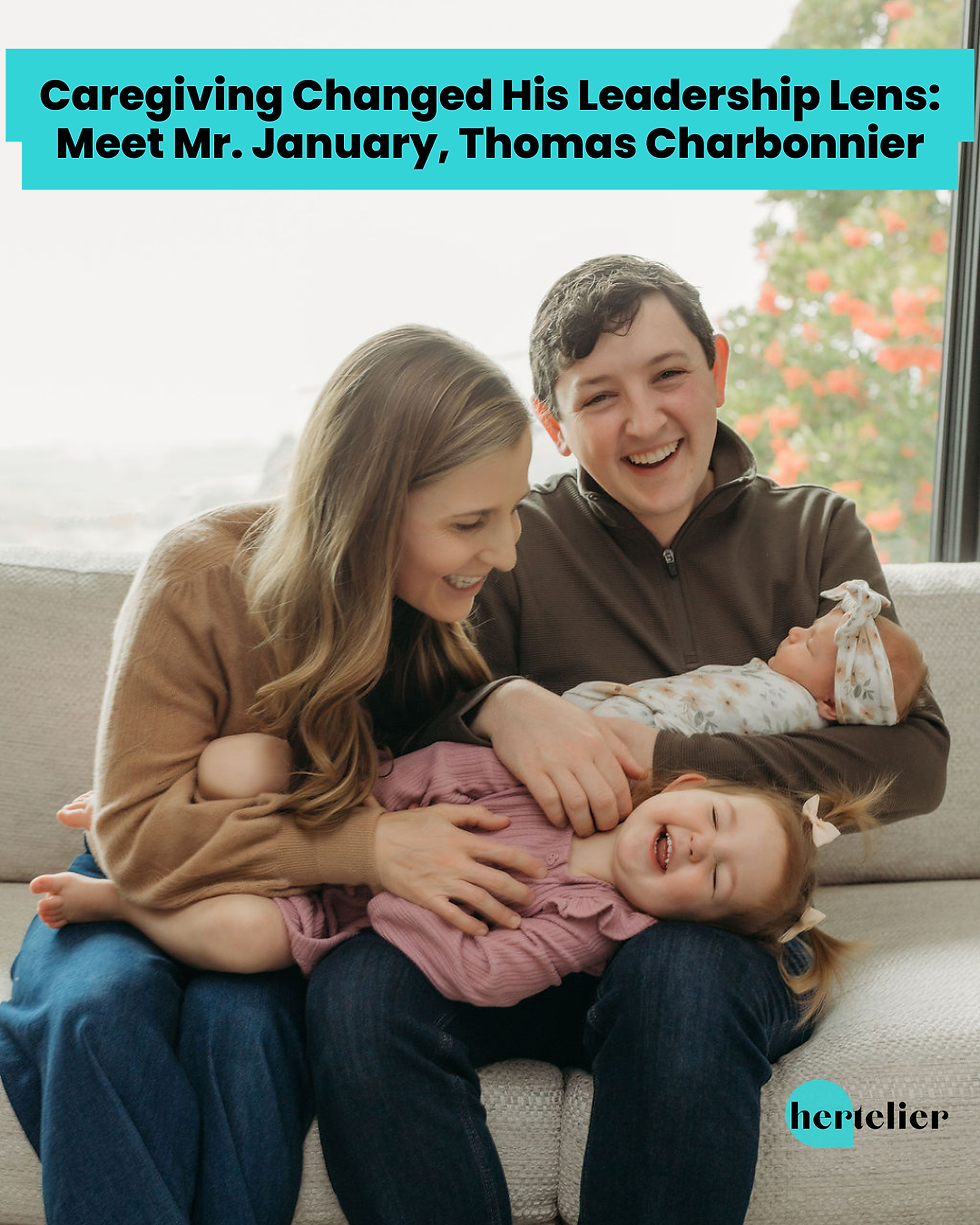
Meet our Mr. January, Thomas Charbonnier. A graduate of the Cornell Nolan School of Hotel Administration and a hospitality HR leader (Four Seasons, Hilton, Waldorf Astoria, Omni Hotels, and a Bay Area startup), Thomas caught my attention with a vulnerable LinkedIn post about being laid off last fall, welcoming his second daughter, Tessa, and then navigating open-heart surgery for her at just three weeks old.
I loved the way he used LinkedIn to talk about caregiving from a dad’s perspective, not as a headline, but as real life: overnight feedings, dealing with illness, a job search, and the perspective shift that comes with all that. And because caregiving still lands disproportionately on women, it’s heartening to hear stories of couples working toward something closer to equal, and to hear a male leader talk about it with candor, not heroism.
It was great to chat with Thomas about how fatherhood has reshaped his leadership lens, what hospitality can do better for working parents, and the small changes that make a big difference in whether people feel included, supported, and able to thrive.
What first drew you to hospitality?
It was homegrown. My parents love hosting people. We were always having parties in the neighborhood growing up. Every Friday night there was a crowd of friends there, and welcoming somebody into your own home is hospitality at its most basic.
My best friend’s dad owned a pizza shop, so we spent summers working there on the South Shore of Boston. He made pizzas, and my buddy and I were on the cash register and phone. That’s where I got my first customer service skills. Later I worked at Olives in Boston, one of Todd English’s flagship restaurants back then. Funny enough, Todd’s son Oliver also went to the hotel school and was my freshman roommate.
Those experiences led me to study hotel management at Cornell.
Walk us through your career journey after Cornell.
In school, I wanted to go into food and beverage. I concentrated in beverage management and after graduating, joined Four Seasons as a food and beverage trainee.
Then I had an early moment of clarity. It was my first Christmas Eve alone working while my family was elsewhere together. I realized that lifestyle wasn’t going to work for me long term. I wanted to stay in hospitality and add value strategically with more quality of life.
That’s when I knew I wanted to transition, and HR felt like the right path because people deliver the service. How can I be their internal service provider? A classmate told me about an opening at the Waldorf Astoria in New York, and my now wife was living there at the time, so it all lined up.
What did the Waldorf Astoria chapter teach you about the people side of the business?
The Waldorf was a tough place to be, and it was a pretty male-run leadership structure at the time, so it mattered to see different viewpoints in action. I enjoyed working with Abby Murtaugh early in my career and I also loved working alongside my Cornell classmate Jessica Tapfar.
I wanted to move right into HR, but the GM, Eric Long, made the right call that I spend time in operations first. That’s where I learned relationships matter, especially in a union environment. You can get a lot more done when you know people and what makes them tick.
I was also there through the closure. I was responsible for about $150 million worth of severance obligations and the logistics behind those payments happening correctly and timely, and there really wasn’t a system to do it.
One moment that stayed with me was a steward who came to HR and asked to look at his file. He wanted his job description because he had to write a resume for the first time in 30 years. That was an aha moment that we needed to do more to support the team through transition. We put together resume building and interview prep. Of the 1,300 employees impacted, about 70 took part.
You moved to the Bay Area and later into a startup. What pulled you there?
My wife is from the Bay Area, so we moved to be near my in-laws, which is fantastic with little ones.
I joined Omni in San Francisco in June 2019. Then March 2020 rolled around, and San Francisco was one of the hardest hit markets. The hotel was closed for about 18 months. During that time, I absorbed a lot more work as an area HR director, including supporting multiple hotels and the call center.
From there I moved into a startup, a ghost kitchen operator. It was my first real startup environment, and I got experience I never would have had in a bigger company, including implementing a new payroll system, a HRIS system and running the payroll. I also whittled about 20 kitchens down to two. I learned so much, but I also kind of knew that by adding so many efficiencies, I was working myself out of a job.
In your LinkedIn post, you wrote that being laid off turned out to be a gift. Why?
It was the timing. I was laid off in September and our baby Tessa was born in November. The holidays were coming, and I thought, who’s hiring in December?
I did outreach and networking. I actually got a job offer during the week we had the baby, and I didn’t feel quite right about it, so I passed.
We also knew before she was born that she had a congenital heart defect. Surgery was expected later, but symptoms came up and our cardiologist moved it sooner. We got the call on a Thursday: come to Stanford for pre-op on Friday, and surgery Monday.

How is Tessa now?
She’s great. She had the surgery at three weeks old. The operation took about two and a half hours all in. She was off real painkillers in 24 hours, just on Tylenol.
Developmentally, I don’t think she’ll be delayed because she had the surgery so early. It was valve-sparing surgery. The hope is there isn’t any other surgery later in life. It’s possible, but after our experience at Stanford, I’d feel completely confident going back if we ever needed.
How has fatherhood changed your perspective on work and leadership?
Having our first daughter changed my perspective because I wanted to be more available and more around. The Bay Area also opened my eyes to flexibility, because so many people here have it in a way that traditional hotel work doesn’t. I was tied to a building five days a week.
That was part of why I went to a startup, to have more flexibility and a hybrid schedule. The business model also supported it because the kitchens were spread out geographically, so video calls were normal.
And honestly, my HR background helped my family perspective. I’m used to compartmentalizing and focusing on what needs to happen. When it came to Tessa’s surgery, there wasn’t time to sit around and feel bad about it. It was, this is what we need to do to get our kid healthy, so let’s move.
What can hospitality do better for working parents?
There will always be jobs that need to be done in person. That’s the nature of hospitality.
One of the best ways we can do better is parental leave. There are companies that do it well, and many that don’t.
And it’s also the little things. The team outing that defaults to happy hour at 5:30 can quietly exclude parents and caregivers. I’d rather make it a 2:00 activity during the workday so it doesn’t bump up against daycare pickup or other obligations.
What have you learned about supporting working parents from your HR seat?
I’ll have more awareness of what parents or other caregivers might be going through behind the scenes. Even showing up on time in the morning as a new parent is a big deal.
In my last role, we had new moms who traveled to our head office for work. My wife was pumping at home, so I started thinking about how to make that experience easier. Know where the lactation room is. Get the keys. Make it easy. Reduce the friction.
There’s no one-size-fits-all, and there’s a fine line between being supportive and getting into personal details. The goal is to make support simple.
You’re job searching right now. What’s your approach and what’s broken in hiring?
This is the first time I’ve had to do it without having a job, and I’m approaching it intentionally. I don’t love the easy apply option. If I see a role, I want to dig into the company, understand the values, and ideally connect with someone on LinkedIn before I apply. Otherwise it can feel like throwing your resume into a black hole.
I’ve always looked at job search as a two-way dialogue. I want context about the role, the company, and the person I’d be working with before I hit apply. And if it’s not a fit, tell the candidate. Even if it isn’t positive news, it’s news. The silence is unnecessary. With today’s tools, an automated rejection notice should be easy.
I’m also trying, to the extent possible, to stick to what matters to me and not settle for something that isn’t the right fit. I realize not everyone has that luxury. Flexibility is a big piece too. I enjoy being in the office, but rigid schedules don’t always work with daycare drop-off and pickup.
A leadership principle you try to live by?
At Four Seasons, the golden rule was to treat others the way you want to be treated. The platinum rule was to treat others the way they want to be treated. For me, it’s about supporting your colleagues in the best way you can, trying to understand and be empathetic to what they’re going through.
Quickfire with Thomas
What’s the most surprising thing you learned about yourself after becoming a parent? You can make a lot happen in a small amount of time. You’ve got to sacrifice somewhere. But if you make a plan for the day, even when it doesn’t go perfectly, you still have direction.
What’s the part of juggling work and caregiving that people don’t talk about enough? With our first daughter, we had a medical situation where we had to do a 3:00 a.m. bottle for months. Just because you’re out of the woods in one traditional sense doesn’t mean there isn’t more happening that affects you at work. Maybe it’s a 9:30 call instead of an 8:30.
Do you have a household system that works? Regular communication. Coordinating around nap time, doctor appointments, and schedules.
Your morning routine? Workout. Shower. Coffee. Breakfast is optional.
One parenting hack you swear by? A countertop bottle washer. Total luxury item, but a lifesaver.
What are you doing for self-care right now? Exercising again. Running, Peloton, the basics.
One workplace policy you’d fight for forever is: Paid parental leave.


